How construction crews, last-mile operators, and seasonal businesses pair a core lease with fleet rentals, and how it changes the math on seasonal demand
The Seasonal Pulse Problem: Why a Fixed Fleet Costs You More Than You Think?
Spring arrives, and so does the crunch. Contracts land, demand spikes, and suddenly your current fleet isn't enough. You need more trucks, more vans, more wheels on the road. But unfortunately, those vehicles aren't waiting in a lot for you. Right now, lead times for new pickups and light commercial vans across Canada sit at 12-15 weeks, and that's on a good model in a stable year, based on Foss National Leasing fleet data, Q1 2026.
For fleet managers and business owners in construction, landscaping, and other industries with irregular demand, this is a familiar headache. Your business has a seasonal pulse. And that pulse accelerates every spring.
If you build your fleet around peak demand, you're paying for trucks that sit idle every off-season. If you build it around base demand, you're scrambling every time work picks up.
Neither approach is good for your total cost of ownership (TCO). The first inflates your balance sheet with depreciating assets. The second costs you contracts.
The Pre-Order Gap
Some managers try to solve the problem by pre-ordering vehicles in advance. This is a smart strategy if your project pipeline is perfectly predictable. But what if it is not? Win more work than expected? You're short. Miss a few contracts? You're sitting on assets you don't need. In a market shaped by seasonal demand scaling, fixed solutions carry real risk. There's a better way to think about this.
How to scale your fleet for seasonal demand?
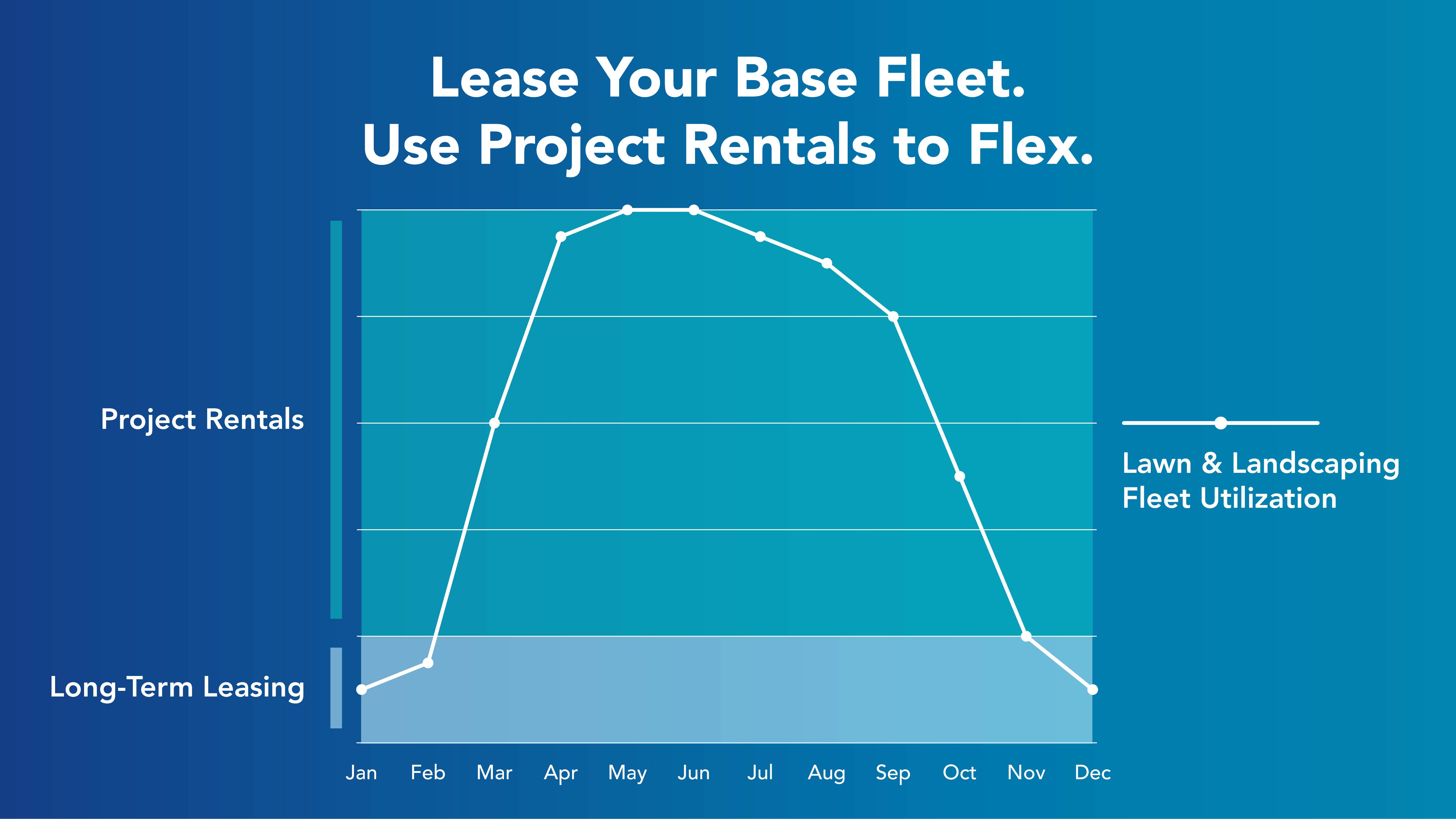
Right-size your core fleet, then supplement with rentals when demand peaks. Lease your base line vehicles. Use short-term leasing to flex. That way, you keep your permanent vehicles right-sized for your core operations, and you bring in work-ready units within days, not months, when demand spikes.
What is a fleet rental?
A fleet rental is a month-to-month vehicle lease arranged through a fleet management company, with no early termination fees, commercial mileage allowances, and work-ready vehicle configuration.
Fleet Rental vs. Ownership, Leasing, and Retail Rental
Not every fleet decision looks the same. The comparison that matters depends on your sector and how your business acquires vehicles today.
|
★ Peak demand
|
Core Fleet
|
|
|
|
Fleet Rental |
Business Lease |
Retail Rental |
Ownership |
|
| Upfront Cost | ✓ None | ✓ Low | ✓ None | ✗ High |
| Flexibility | ✓ High | ✓ Predictable | ✓ High | ✗ Low |
| Best For | ✓ Surge demand | ✓ Core fleet | ✗ Personal use | ✗ Stable demand |
| Availability | ✓ Days | ✓ Factory ordering | ✗ Fast but not work ready | ✗ Weeks |
| Wear & Tear | ✓ Commercial | ✓ Commercial | ✗ Consumer | ✗ Owner bears all cost |
Fleet Rental vs. Ownership
Construction companies, for instance, have traditionally owned their light commercial fleet outright. You buy the truck, you run it hard, you sell it when it's done. The problem is that ownership ties up significant capital, and the total cost of ownership is higher than most owners realize.
Depreciation alone accounts for approximately 35-40% of TCO based on Foss National Leasing fleet cost data, 2025.
When you add insurance, maintenance, registration, and the opportunity cost of that capital, ownership starts to look a lot less efficient. And when your project ends early, you're stuck with an asset you're paying to park.
Short-term commercial vehicle rentals flip that equation. You pay for the vehicle while you're using it. When the contract closes, the vehicle goes back. No residual risk, no disposal headache, and no trucks sitting in your yard eating up costs.
Fleet Rental vs. Retail Rental
Opposite to construction, most operators in last-mile delivery are already renting. The question is whether they're using the right kind of rental.
When fleet managers first reach for a vehicle to fill a gap, the instinct is often to call a retail rental company with daily or weekly rates. It is familiar, fast, and available. But those vehicles aren't built for commercial work, and the costs catch up with you quickly.
Here's what you run into when you put a retail rental van into a last-mile operation:
- You get a clean consumer vehicle with no commercial configuration. No shelving, no load management, no upfitting. If your crew needs the van to do actual work, you're spending money on add-ons that stay behind when you return the keys.
- Mileage caps are written for road trips, not delivery routes. A last-mile driver can exceed a standard daily rental limit before their second run. Overage charges compound fast across a fleet.
- Wear and tear policies are designed for personal use. Run a van hard through a full delivery season, and you'll be paying for every scratch at return.
- There's no fleet management integration. No telematics, no consolidated invoicing, no fuel reporting. In a retail rental, you have zero visibility into what the vehicle is doing, where it is, or what it's actually costing you day to day.
Retail rental companies have also reduced their commercial inventories significantly since 2020. Availability is tighter, rates are higher, and the vehicles are still configured for consumers. When you're running vans month after month, daily retail rates compound into a number that doesn't make sense for sustained operations.
Retail vs. commercial vehicle rental isn't just a pricing question. It's a question of whether the vehicle is actually ready for the work you're asking it to do.
Ryan Hartley, Operations Manager, fleet rentals
A commercial last-mile delivery van rental through a fleet provider is a different product. Work-ready configuration, a mileage policy that reflects actual commercial use (up to 5,000 kilometres per month), and a wear and tear standard built for the field. Foss integrates telematics directly into vehicles, giving you real-time visibility into fuel usage, driver behaviour, and maintenance needs across every vehicle in the program. That's the kind of operational data that helps you optimize fleet costs and justify fleet spend to your stakeholders.
Fleet Rental vs. Long-Term Business Leasing
Right-sizing works much better here. Long-term leases are a natural fit for vehicles you need year-round on a long-term business vehicle lease. But landscaping, snow removal, and other seasonal businesses often need a surge of vehicles for four to six months, then see demand fall off sharply. Signing a three-year lease on that surge capacity means paying for vehicles during the months they're sitting.
A hybrid approach works much better here. Lease the vehicles your core crew uses year-round. Bring in short-term leasing for spring vehicle demand when your headcount and workload peak. When the season winds down, return the rentals. You pay for your actual use, nothing more.

Should You Use A Project Rental? Run The Checklist
Consider fleet rentals if you check any of these boxes.
Project uncertainty
|
Seasonal factors
|
Financial flexibility
|
Operational requirements
|
What This Looks Like In Practice?
Say you've secured a six-month construction contract that needs two pickup trucks and a cargo van. A project rental means no long-term commitment if follow-on contracts don't materialize, maintenance covered through your busy period, and the option to return the vehicles early if the project wraps ahead of schedule.
What Fleet Rentals Do To Your Cash Flow?
No matter if you are in Ontario, Alberta or Nova Scotia, buying trucks ties up capital that could be used to pay your crew or fund your next bid. Long-term leases on surge vehicles mean paying for assets that sit idle half the year. Commercial fleet rentals solve both problems.
- Your cash stays free. A project rental requires no down payment and no large capital outlay. You get the vehicle on the road with a monthly rate that stops when the project stops.
- A higher monthly rate can still be the cheaper decision. Measured month to month, a rental costs more than a long-term lease payment. Measured across a season, with no capital outlay, no idle months, no residual exposure and no disposal to manage, it usually costs less. Compare total cost over the period you'll actually use the vehicle, not the monthly line item.
- The wear and tear policy is designed for commercial use. These vehicles work for a living, and the policy reflects that. You're not going to get dinged for every scratch and scuff the way you would with a consumer rental company. Your drivers can focus on the job.
- True month-to-month flexibility. When you're done with the vehicle, the payment stops. One-month minimum, pro-rated rates, no early termination fees. That's a fundamentally different financial risk profile than a three-year lease or an owned vehicle. Fleet flexibility is a balance sheet advantage.
- Speed when you need it. Lead times on new pickups are still running 12-15 weeks. Foss's program delivers work-ready vehicles across Canada, often within days of an agreement. That speed matters when your business moves on contract cycles, not calendar quarters.
- Built-in visibility. Every short-term lease can be paired with Foss's telematics and fuel management tools. That means real-time visibility into where your vehicles are, how they're being driven, and what they're consuming. Fuel exception reports catch waste early. Consolidated monthly invoicing keeps your accounting clean. Maintenance history follows the vehicle, so nothing falls through the cracks.
How Canadian Businesses Use Fleet Rentals to Stay Competitive?
The businesses that are growing their fleets most effectively right now aren't the ones that own the most vehicles. They're the ones with reliable access to the right vehicles at the right time.
A right-sized core fleet, supplemented with short-term fleet rentals when demand peaks, gives you the best of both worlds. Predictable costs on your permanent fleet. Speed and flexibility on the vehicles you need to chase opportunities.
When supply chains stop moving?
With vehicle wait times across Canada exceeding a year, Amrize, a leading North American building solutions company, kept every project moving on work-ready rentals delivered within days, across multiple teams and job sites. What started as shortage coverage in 2021 became a long-term fleet partnership.

That's what access looks like in practice. Not ownership of depreciating assets. Not a retail rental that wasn't built for your work. Access to the right commercial pickup for construction, the right last-mile delivery van rental, the right seasonal vehicle exactly when the season starts — and none of the cost when it ends.
Your fleet, your way. Let's figure out where fleet rentals fit.
Not sure where short-term rental fits in your fleet mix? We're happy to think it through with you. Talk to a Foss specialist.
Get to Know the Author
Ryan Hartley leads Project Rentals operations at Foss National Leasing, bringing 15 years of hands-on fleet experience to every conversation. He's worked across nearly every corner of the business, from operations to client service to sales, so when he talks about finding the right fleet solution, he's speaking from real experience. When he's not solving fleet problems, you'll find him on skis or a bike.
Meet our team